ESM'2025 - GAME-ON 2025 Keynotes and Invited Speaker
Modelling Machine Intelligence Measuring
Abstract
The number and variety of intelligent systems being used for real-world problem-solving in all domains is growing rapidly. In this context, modelling the measurement of machine/system intelligence becomes of utmost importance. Modelled machine intelligence metrics presented in the scientific literature are based on different philosophies, which hinders their effective comparison. There is no standardization of what machine intelligence is and what should be measured to quantify it. This study examines the measurement of the intelligence of artificial complex computing systems from the perspective of their ability to solve real-world difficult problems and highlights the importance of being able to make accurate and robust comparisons of intelligence within multiple intelligent complex systems. The most important property of an intelligence metric must be universality, based on the very large diversity of intelligent complex systems. In this sense, an important approach consists of modeling black-box-based intelligence metrics that should be able to handle aspects like variability in intelligence and extreme intelligence (rare very low, and high intelligence manifestations in different situations). Modelled universal black-box-based machine intelligence metrics represent a useful tool for intelligent system developers to measure the intelligence of their systems with the intent to compare it with the intelligence of other systems regardless of the diversity of their architectures.
The lecture will discuss selected issues related to machine unlearning, i.e., how to remove the influence of a specified subset of training data from a machine learning model.
Curriculum Vitae
L.B. Iantovics obtained a BSc and MSc in Mathematics and Informatics from the Transilvania University of Brasov; a Ph.D. in Artificial Intelligence (AI) from the Babes-Bolyai University of Cluj-Napoca and completed a Postdoctoral study in AI at the Alexandru Ioan Cuza University of Iasi. In 2020 he attained a habilitation degree at the George Emil Palade University of Medicine, Pharmacy, Science and Technology of Targu Mures (UMFST). Dr. Iantovics since 2020 is Ph.D. supervisor at the Doctoral School of UMFST and Full Professor since 2021. Since 2018 is the Director of the Research Center on Artificial Intelligence, Data Science, and Smart Engineering (ARTEMIS) at UMFST. His main research directions are related to Artificial Intelligence, Data Science, and Applied Statistics with particular topics approached like: intelligent systems, measurement of machine intelligence, in-depth performance analysis of algorithms, and data analytics intelligence applied mostly in health sciences.
He published dozens of papers and book chapters on these topics and contributed to research projects as project leader or researcher. Contributions to international research project coordination include: Hybrid Medical Complex Systems (ComplexMediSys); Electronic Health Records for the Next Generation Medical Decision Support in Romanian and Bulgarian National Healthcare Systems (NextGenElectroMedSupport) and Social Network of Machines (SOON) among others. Dr. Iantovics has acted as a committee member at numerous prestigious conferences, has reviewed papers in several prestigious journals, has been a member of the editorial board of multiple journals, and has organized conferences as General Chair and Principal Scientific Organizer such as BICS, CANS, UICS, etc. He has edited valuable books and journal special issues, such as "Advanced Intelligent Computational Technologies and Decision Support Systems"; "Advances in Intelligent Analysis of Medical Data and Decision Support Systems", published in the Computational Intelligence series; "Advanced Computational Technologies", published by the Romanian Academy Publishing House, and others.
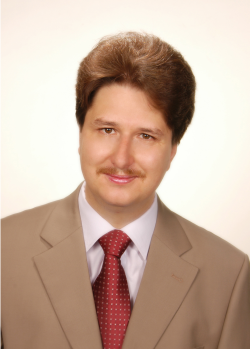
Full Professor at George Emil Palade University of Medicine, Pharmacy, Science and Technology of Târgu Mureș, Romania
Director of the Research Center on Artificial Intelligence, Data Science, and Smart Engineering (ARTEMIS)
FUTOM: A FUzzy Tensorial Object Model to implement an Object Composition and Synthesis Generative Artificial Intelligence (OCSYGENAI) with Comprehensible Reasoning Processes
Abstract
Deep-learning algorithms are based on calculation of 2D tensors (vector data), 3D tensors (time series), 4D (images) and 5D (videos) encoded in neural networks trained on data sets to perform a classification in order to recognize situations or images. Deep learning is only relevant if the data set is sufficiently large and representative of the situations to be recognized. Generative AI (GAI) relies on a top-down statistical classification learned with a limited selection of attributes that does not take into account the structure, dynamics of objects and relationships between them (ontology). GAI is therefore a black box that does not implement any reasoning or knowledge capable of justifying the results obtained and informing the user about the limitations associated with the learning data sets.
We propose a Fuzzy Tensorial Object Model FUTOM which is a natural tensor extension of our previous multidimensional FVSOM model (Fuzzy Vector Space Object Model) that relies on the robustness of the composition (+) and synthesis (x) operators of our object model and offers a bottom-up inheritance from the attribute layers, simple objects layers to complex objects layers along the object composition hierarchy. The semantics of the relationships between components is expressed using the junction objects implanted in this composition hierarchy. The fuzzy characteristic function of FUTOM provides a homogeneous encoding and learning of attributes, simple objects (with attributes only) and complex objects (composed of objects). Indeed FUTOM is truly a new Object Composition and Synthesis Generative Artificial Intelligence (OCSyGenAI) that realizes a bottom-up learning of knowledge objects emerging from the structure, relationships and values of qualifying attributes representative of the target application domain which are sorted, indexed and stored in the object case base. Finally, reasoning modes like induction, abduction, subsumption, analogy exploit these knowledge objects in order to implement and to explain the successive stages of the decision-making process in a comprehensible way.
Short Biography
Joël Colloc is Emeritus Professor of Le Havre Normandy University. He earned his M.D. at the medical faculty of Lyon and a specialty degree of forensic medicine with a degree of clinical toxicology. He received a MSc. degree of IT from the Business School of Lyon (IAE) and a MSc. degree of computer sciences from the engineering school INSA of Lyon. He served as forensic physician at the Edouard Herriot Hospital in the neurological emergency department to cure drug addicted people, medical ethics and developed drug and addiction database. He went on to earn his Ph.D. in computer sciences at the INSA of Lyon.
As Hospital assistant at the laboratory of medical computer science and he taught IT at the medical faculty. He was elected as associate professor in computer sciences at IAE of Lyon and he earned his accreditation to supervise researches in sciences at the Lyon 1 University. He is a Le Havre Normandy University professor in computer sciences since 2003.
His main research topics concern e-health and particularly: fuzzy vectorial spaces (FVS), multi-agent clinical decision support systems (MADSS) and knowledge bases, Case Based Reasoning, ontologies, nervous system modeling and cognitive sciences and AI applications in medicine and human sciences.
His human sciences researches try to conciliate the ethics of using Big Data in epidemiological studies, autonomous systems and robots and keeping ethics use of AI in order to improve clinical decision in medicine while preserving the patient-caregiver relationship, the privacy and the freewill choice of the patients.

Université of Le Havre
Le Havre,France
 The Craft of Creating Analog Serious Games for Preparedness and Planning
Abstract
There are fascinating analog, board, card, and many other games being developed and available in the market that push design boundaries to deliver engaging game experiences, some of which address realistic topics and situations. These are not serious games, but they can teach us essential design lessons. When we develop analog serious games, we must be aware of all the design innovations that new games propose, especially those that propose complex systems that try to mimic detailed and realistic themes. However, serious games' overall development differs considerably from commercial and entertainment, with other requirements and goals demanding other resources.
This presentation will focus on the research and practical experience of developing serious games, the resources, the tools, and the coordination between experts collaborating to deploy analog serious games. From personal and individual projects, some done directly to clients like municipalities, enterprises, and the Portuguese Government, and others applied to research projects developed at the University of Coimbra and University College Dublin; this communication will also present some of the projects developed as chief game designer at the Center for Advanced Preparedness and Threat Response Simulation (CAPTRS).
Curriculum Vitae
Micael Sousa has degrees in Civil Engineering and History. Masters in Energy and Environment and Heritage Studies. He has a PhD in Spatial Planning (University of Coimbra/Porto). He did his post-doctoral research at University College Dublin. CITTA, Hei-Lab and was a ciTechCare Research collaborator. He is also an ISAGA and SPCV member while being a serious games consultant/expert for participatory and collaborative planning: www.msseriousgames.com. he is also a guest lecturer and instructor at several institutions and universities. At present he is a chief game designer at the Center for Advanced Preparedness and Threat Response Simulation (CAPTRS). Furthermore he is a board game reviewer, designer, developer, and content creator.

Invited Speaker
Detecting and Correcting Semantic Inconsistencies in Heterogeneous System Modeling Views
Abstract
Model-Based Systems Engineering leverages multiple, interconnected views to simplify system analysis and design. Yet ensuring consistency across these heterogeneous views, particularly when encoding fine semantic and logical dependencies of complex systems, remains a difficult challenge. This issue is also critical when it comes to co-simulation, where it is essential that each simulation faithfully represents the execution of the same underlying system. Traditional consistency‐management techniques (typically formal, rule‐based methods sometimes augmented with ontologies) have been proved effective in handling most of consistency issues, but often struggle to resolve deeper semantic conflicts or fully verify cross‐view logical dependencies.
In this talk, I will present a framework for the automated detection and correction of inconsistencies across system views. This framework, which has been initially introduced at the MODELS '24 conference, combines two complementary approaches:
- - a LLM‐assisted loop for analyzing and aligning concepts across modeling views.
- - a model annotation- and transformation-based method that enables consistency analysis (with respect to logical dependencies) of any model, diagram, or view that can be transformed into a graph structure.
Curriculum Vitae
Bastien Sultan is a research fellow with the LabSoC research team at Télécom Paris. His work focuses on model-driven engineering, formal methods, and AI-assisted techniques to support and enhance MDE processes. In recent years, his research has addressed topics such as incremental transformation and verification of formally defined SysML models, ensuring semantic consistency across multiple modeling views, and automating text-to-model transformations. His research has been applied to the safety, security, and performance evaluation of cyber-physical systems in several contexts (maritime systems, industrial control systems, and robotic platforms). Before joining Télécom Paris, Bastien worked as a cybersecurity engineer at Thales on a space system, and held research positions at Mines de Saint-Étienne, the French Naval Academy and IMT Atlantique. He holds an Engineer's degree from ENSTA Bretagne, a Master's degree in Mathematics and applications from the University of Angers, and a PhD from IMT Atlantique.

LabSoC research team
Télécom Paris
France