ESM'2026 Keynotes and Invited Speakers
INDICIA: An Assessment Indicator for Healthcare AI Systems that focuses on the Caregiver-Patient Relationship and Algorithmic Transparency
Abstract
Today, many applications of artificial intelligence (AI) are offered in medicine with applications more or less respectful of the care relationship and personal data of patients.
There are also many different models, methods, and tools that claim to be artificial intelligence, sometimes qualified from "weak AI" to "strong AI."
Several frameworks have already been developed to assess the ethical risks of the applications of AI algorithms in many medical specialties which are themselves very numerous and
that relies on different decision processes. Thus, the potential use cases of artificial intelligence in healthcare are very numerous and complex. It is necessary to take into account
the types of health applications or devices, the actors involved with their respective roles: developers, suppliers and potential users: more or less specialized and experimented caregivers
involved in the caregiver-patient relationship.
The degree of autonomy of the systems, data sources, artificial intelligence algorithms used and quality and software engineering criteria, legal benchmarks (GDPR, AI-Act).
We therefore propose a new indicator called INDICIA that evaluates the different benefits/risks of proposed medical systems using AI according to a method that results from experience with AI and different approaches to AI in health. In the first part, the proposed approach takes into account the ethics of AI (6 axes): (Technological, semantic, acceptability, complexity, population, actors) along with European legal regulations (GDPR and AI-Act) and quality technical specifications related to software engineering. The ethics of AI in health must necessarily be based on medical ethics: general references from the National Ethics Advisory Committee (Comité National Consultatif d’Ethique) and specific references to adapt it to each patient using a field ethics method, that we published in 2008. The method is based on the caregiver-patient relationship where privacy and consent that ensure the trust necessary for the practice of medicine are shared, while respecting medical confidentiality in a context where health data stored in the institutions is increasingly shared, disclosed or cyberhacked.
The INDICIA indicator we propose is developed using a time fuzzy vector space object model (FVSOM), whose component objects define the axes of our model in order to show the evolution of (benefits/risks) of AI tools. AI applications and devices in health according to criteria expressed by the attributes of these objects.
These guidelines originate from models conceived by scholars and experts in AI. INDICIA is showing the strengths and weaknesses of each category of AI models with some examples.The modularity of our approach offers the possibility to reuse the first 6 axes of the indicator with some legal and software engineering milestones, in order to adapt it and to further propose general AI ethics guidelines.
Short Biography
Joël Colloc is Emeritus Professor of Le Havre Normandy University. He earned his M.D. at the medical faculty of Lyon and a specialty degree of forensic medicine with a degree of clinical toxicology. He received a MSc. degree of IT from the Business School of Lyon (IAE) and a MSc. degree of computer sciences from the engineering school INSA of Lyon. He served as forensic physician at the Edouard Herriot Hospital in the neurological emergency department to cure drug addicted people, medical ethics and developed drug and addiction database. He went on to earn his Ph.D. in computer sciences at the INSA of Lyon.
As Hospital assistant at the laboratory of medical computer science and he taught IT at the medical faculty. He was elected as associate professor in computer sciences at IAE of Lyon and he earned his accreditation to supervise researches in sciences at the Lyon 1 University. He is a Le Havre Normandy University professor in computer sciences since 2003.
His main research topics concern e-health and particularly: fuzzy vectorial spaces (FVS), multi-agent clinical decision support systems (MADSS) and knowledge bases, Case Based Reasoning, ontologies, nervous system modeling and cognitive sciences and AI applications in medicine and human sciences.
His human sciences researches try to conciliate the ethics of using Big Data in epidemiological studies, autonomous systems and robots and keeping ethics use of AI in order to improve clinical decision in medicine while preserving the patient-caregiver relationship, the privacy and the freewill choice of the patients.

Université of Le Havre
Normandie University
Le Havre,France
Beyond LLMs: Structured World Models via Difference of Convex functions Algorithm
Abstract
The remarkable success of Large Language Models and generative AI has opened a new era of artificial intelligence, but it also highlights a fundamental challenge: moving from generating plausible information to understanding, reasoning about, and making decisions within complex environments. This challenge calls for world models capable not only of representing how an environment behaves, but also of incorporating actions, constraints, interactions, and objectives.
This talk explores a perspective that goes beyond LLMs and purely generative models, by introducing optimization as a fundamental component of structured world models. In particular, Difference-of-Convex functions (DC) programming and the Difference-of-Convex function Algorithm (DCA) offer a natural framework for integrating learned representations with explicit mathematical structure and nonconvex decision-making.
The central idea is to view a world model not simply as a predictive or generative model, but as a structured computational model of an environment, in which learning, generation, optimization, and decision-making interact. Generative models can provide rich candidate representations and possible scenarios, while DC optimization and DCA can impose structure, incorporate constraints, and refine these candidates toward high-quality decisions. This creates a bridge between the expressive capabilities of modern AI and the mathematical rigor of nonconvex optimization.
The talk will discuss how this perspective can lead to a new generation of DCA-powered structured world models, with potential applications in robotics, logistics, autonomous systems, and other complex decision-making environments. Beyond the current paradigm of scaling models for generation and prediction, the objective is to develop AI systems that can generate, reason, optimize, and act within structured worlds.
This perspective suggests a broader role for optimization in the future of AI: not merely as a tool for training models, but as an intelligence engine embedded within generative and world-model architectures.
Curriculum Vitae
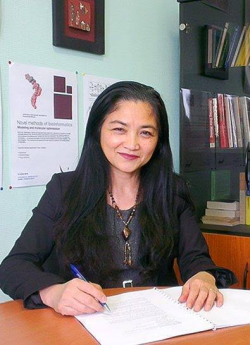
Prof. Le Thi Hoai An earned her PhD with Highest Distinction in Optimization in 1994. From 1998 to 2003 she was Associate Professor in Applied Mathematics at the National Institute for Applied Sciences, Rouen, and from 2003 to 2012 she was Full Professor in Computer Science at the University of Paul Verlaine – Metz. Since 2012 she has been Full Professor exceptional class, University of Lorraine. She is the holder of the Knight in the Order of Academic Palms Award of French government in July 2013. She obtained the Rosenbrock Prize 2017 of Springer awarded to the authors of the best paper published in the journal Optimization and Engineering., she was nominated a Senior Member of the Academic Institute of France (IUF) since June 2021, and received the 2021 Constantin Caratheodory Prize of the International Society of Global Optimization which rewards outstanding fundamental contributions that have stood the test of time to theory, algorithms, and applications of global optimization. She is the author/co-author of more than 300 journal articles, international conference papers and book chapters, the co-editor of 24 books and/or special issues of international journals, and supervisor of 40 PhD theses/Habilitation and is the leader of several great joint projects in Industry 4.0 framework with Big companies including RTE (French transmission system operator) and NAVAL group (the European leader in Naval defence and a major player in marine renewable energies). Prof. Le Thi Hoai An is the co-founder of DC programming and DCA with Professor Pham Dinh Tao.
Multiscale Numerical Simulation for Steelmaking Process Decarbonization and Optimization
Abstract
Research at ArcelorMittal spans the full steel production chain, from raw materials to downstream processing and covers a wide range of disciplines such as reactive multiphase flow, heat and mass transfer, thermodynamics, and advanced sensing in harsh environments. These efforts combine state-of-the-art experiments with multiscale modeling to link fundamental mechanisms to process behaviour and capture complex interactions across the scales. Increasingly, these physics-based models are enhanced by data-driven methods and artificial intelligence, which act as key enablers for handling complexity, improving predictive capabilities, and accelerating innovation.
This presentation gives an overview on some ongoing research challenges and highlights how simulation and AI are advancing modelig capabilities and shaping the future of steel production.
Curriculum Vitae
After three years at Arcelormittal research center (Maizières les metz) as a R&D engineer, I started a phD in machine learning. The goal of this thesis was to provide solutions for automatic tuning of an algorithm (the quadratic variant of the support vector machine). Using the regularization path, we achieve a very efficient algorithm for both the dichotomic and multiclass case. Generalization estimators were developed and used in order to allow for efficient model selection. Following this theoritical experience, I wanted to work in the field of medical devices. For 8 years, I working as R&D manager for APD Advanced Perfusions Diagnostics. My main tasks were to develop an innovative device (and algorithm of course) to monitor tissue perfusion. This role implied management skills (medical device design, manufacturing supervision, team leadership, planning) as well as field related skills (hemodynamics, near infrared spectroscopy, EMC,... ) the design as well the as the supervision of the manufacturing. I was also responsible for Quality Assurance & Regulatory Affair for CE marking and FDA approval preparation.
While this experience was very fulfilling, I wanted to go back on a technical position in order to be sure to keep in touch with machine learning and statistical analysis So when Vygon acquired APD by Vygon, I joined ArcelorMittal R&D center as a senior data scientist. I now bring my technical expertise in machine learning and data analytics as well my experience in various field to propose the most efficient way to formalize problem, solve and then implement them.

Invited Speakers
Multi-Method Simulation Software AnyLogic. Current Features and Road Map
Abstract
In modern simulation modeling for business systems, there are three main approaches: system dynamics, discrete event and agent-based modeling. All three modeling approaches are quite independent. Each has its own tool set, unique features, strengths, and weaknesses. The choice of method should be based on the system under study and the purpose of the modeling.
However, most real-world cases are too complex to be modeled with one method, and it is often convenient to describe different parts of a system with different modeling approaches. A combination of approaches provides the opportunity to create an accurate and multi-functional model of a system without any workarounds. In this presentation, we cover the characteristics of the multi-method modeling and simulation software AnyLogic and its actual features and future development.
Curriculum Vitae
Vladimir Koltchanov holds a Ph.D. in Technical Sciences from the Institute of Cybernetics of the National Academy of Sciences of Ukraine, in Kyiv. He worked as a Research Scientist, Head of Research Laboratory, Deputy Director of Research Institutes in Ukraine and Slovakia.
After working as a University Visiting Professor in France, he worked as a Consultant in Modeling and Simulation in Paris and the Paris region. He contributed to several research and development projects
involving agent-based simulation software for pedestrian and vehicle flows.
Vladimir conducted and supervised studies simulating the flow of pedestrians and vehicles across road networks, shopping centers and exhibition venues for SNCF, RATP, ADP, Orsay, Louvre, Grand Palais,
Stadiums in Paris, Lyon, Bordeaux, St Etienne, Kyiv.
Since 2007 he is the co-founder and Managing Director of the modeling and simulation consulting firm ANYLOGIC EUROPE S.A.S.

Sentiment and Reputation: a New Paradigm
Abstract
This lecture presents a new way of thinking about the concept of “reputation”: one that casts reputation in statistical terms. It is a summary of research into reputation and sentiment analysis over the past ten years. Prior to 2010, reputation was regarded as something that is a secondary effect that cannot be measured directly. Following early papers in the years 2015-2017, that view began to shift towards acceptance of an alternative approach to reputation: one that represents a paradigm shift. Reputation can, indeed, be measured directly, by extensive data mining, followed by sentiment analysis, and then by combining all content received each day into daily sentiment measurements. “Reputation” is then an interpretation of the resulting time series of sentiment values.
Casting reputation as a time series of sentiment values allows statistical analysis of, for example, prediction, periodicity and monetisation, by any appropriate time series technique. Increasingly, Large Language Models (LLMs) have gained prominence in sentiment analysis. Their capabilities in that domain are beginning to be explored. Comparisons with traditional methods show that some LLMs are particularly effective, but others are not, and that there is an upper accuracy limit of approximately 77%. Increasingly, the “LLM + reputation time series” combination is gaining prominence in business decisions making, particularly as it allows reputation to be expressed in €, $, £ etc.
Curriculum Vitae
Peter Mitic has been Honorary Professor in the Department of Computer Science at University College London since 2018, with research interests in operational and reputation risk, and applications of artificial intelligence. He has been devising and supervising masters dissertation projects during that time, with an increasing emphasis on how Large Language Models can be used in sentiment analysis. In parallel, he has published approximately 40 papers on reputation and financial risk, including the 2020 OpRisk Best Paper Award, an account of the Pseudo Marginal method in Conduct Risk.
Prior to UCL he was Head of Operational Risk at Santander Bank UK, 2015-2024, with responsibility for calculating annual operational reserves. Previous roles have been risk-related with major banks, including Barclays, HSBC and Deutsche in London, and ABN-AMRO in Amsterdam. His academic qualifications include: Ph.D. (1999, with thesis title “Computer Algebra Applications in Object-Oriented Mathematical Modelling”); M.Sc. Mathematics and Computing (Open University 1989); and M.A. Mathematics (Oxford 1978). His current project is a book entitled Sentiment and Reputation: a Statistical Approach, published by Taylor and Francis in late 2026.

UCL
London, United Kingdom
A Continuous-Time SIS Criss-Cross Model of Co-Infection in a Heterogeneous Population
Abstract
In this talk, we introduce and analyze a continuous-time model of co-infection dynamics in a heterogeneous population consisting of two subpopulations that differ in the risk of getting infected by individuals with both diseases. We assume that each parameter reflecting a given process for each subpopulation has different values, what makes the population completely heterogeneous. Such complexity and the population heterogeneity make our paper unique reflecting co-infection dynamics. Moreover, we establish an epidemic spread for each disease not only in a sole subpopulation, but also criss-cross transmission, meaning between different subpopulations. The proposed system has a disease–free stationary state and two states reflecting the presence of one disease. We indicate conditions for their existence and local stability. The conditions for the local stability for states reflecting one disease have complicated form, so we made their strengthened version so that they are more transparent. Investigation on the existence of a postulated endemic state corresponding to both disease’s presence leads to a complex analysis, that is why we only give an insight on this issue. In the paper we also provide the basic reproduction number of our model and investigate properties of this number. The system has a universal structure, it can be therefore applied to investigate the co-infection for different infectious diseases.
Curriculum Vitae
Marcin Choiński obtained his bachelor's degree in Mathematics with a specialisation in mathematical methods of informatics at the Technical University of Białystok in 2012. At this university he obtained his engineer's degree in Computer Science in 2013. In 2014 he obtained his master's degree in financial mathematics from the University of Białystok. At this university he also obtained a bachelor's degree in Medical Physics. Later he started his PhD studies in Mathematics at the Warsaw University where he defended his doctorate in 2022. Since 2019 he has been working at the Warsaw University of Life Sciences – SGGW as an assistant professor. His interests lie in mathematical modelling of epidemic dynamics and combined therapy for HIV.
Institute of of Information Technology
Warsaw University of Life Sciences -SGGW
Warsaw, Poland